
The "best hotel bedding" isn't 1,000-thread-count silky sateen — that's marketing. Most luxury hotels use 300-thread-count cotton percale: crisp, cool, slightly stiff, and the actual reason hotel sheets feel like hotel sheets when you slide in.
The hotel bed is a 5-layer system: mattress topper → bottom fitted sheet → top flat sheet → white duvet with insert → 4 medium-firm pillows. Replicating it costs about $600–$1,200 from a non-hotel-brand source — roughly half what hotel-brand stores charge for the same construction.
Skip: hotel-branded bedding shops, sateen sheets, microfiber, anything advertised over 600 TC, "hotel collection" department-store lines. Choose: 300 TC organic cotton percale or washed linen, all-white, GOTS or OEKO-TEX certified, with a separate duvet cover and insert (not a quilted comforter).
Researched and reviewed by the Or & Zon product team — drawing on direct hotel-supply specs, our GOTS-certified Portuguese mill partners, hospitality-trade-association procurement data, and primary research on textile thread count and weave.
Last updated: May 2026 · Reading time: 13 min
📋 Key Takeaways
- The "best hotel bedding" myth — that hotels use 800-1,000 TC silky sheets — is wrong. Industry standard for 4- and 5-star hotels is 250–400 TC cotton percale, almost always white.
- The hotel bed is a 5-layer system, not a single product: mattress topper, fitted sheet, flat top sheet, white duvet cover with separate insert, and 4 pillows.
- Hotels overwhelmingly choose percale weave over sateen because percale feels crisp and cool — that signature "fresh hotel sheet" sensation comes from weave structure, not thread count.
- The all-white palette is intentional: it signals cleanliness, allows industrial bleach laundering, and prevents dye transfer — not because it's more luxurious than colour.
- Hotels use a separate duvet cover with a washable insert, not a quilted comforter, because covers can be laundered between every guest.
- Hotel-brand bedding shops charge a 50–100% premium for construction you can buy elsewhere. The mark-up is brand royalty, not material upgrade.
- Replicating a luxury-hotel bed at home costs roughly $600–$1,200 for the full 5-layer setup in organic cotton.
- Skip "hotel collection" department-store labels — most are 200 TC sateen with synthetic blends. They feel slippery, not crisp.
- To truly out-hotel a hotel: use GOTS-certified organic cotton percale, which the average hotel won't pay for.
1. What Hotels Actually Use (and the Thread-Count Lie)
If you've ever wondered why your sheets at home don't feel like the sheets you remember from your last hotel stay, the answer almost certainly isn't thread count. The hospitality-procurement industry has been quietly using the same range — 250 to 400 thread-count cotton percale — for decades, because anything tighter doesn't survive industrial laundering and anything looser doesn't feel crisp.
The 1,000-TC sheets you see advertised at department stores are usually a marketing trick: most are achieved by counting plies (each yarn split into 3–4 strands and counted multiple times) rather than true single-yarn density. Real 1,000 TC is structurally close to impossible — the cotton fibre has a maximum diameter, and you can't fit more than about 500 single-ply threads per square inch.
What hotels actually pay attention to:
| What hotels prioritise | Hospitality standard | Why |
|---|---|---|
| Weave | Percale (1-over-1) | Crisp hand, breathable, survives 200+ industrial wash cycles |
| Thread count | 250–400 TC | Sweet spot for durability and cooling — 600+ TC is hot and tears under bleach |
| Fibre | 100% long-staple cotton | Egyptian, Pima, or Supima — long fibres pill less and feel smoother |
| Colour | White only | Allows industrial bleach laundering, signals cleanliness, prevents dye loss |
| Wash temperature | 160°F+ (71°C) | Sanitises and helps relax fibres for that crisp finish |
| Finish | Calendered, light starch | Pressed under heated rollers — the secret behind the "ironed" hand |
Three lies the bedding industry sells you about hotels:
- "Hotels use 1,000-thread-count sheets." They don't. Anything above 600 TC is structurally suspicious.
- "Hotels use sateen for that silky feel." Sateen feels silky in showrooms but sleeps hot — hotels use percale precisely because it feels cool.
- "Hotel sheets are softer than home sheets." They're often stiffer on first feel — the softness is the calendering finish, not the fibre. After 5–10 washes at home, percale softens dramatically.
2. The 5-Layer Hotel Bed Formula
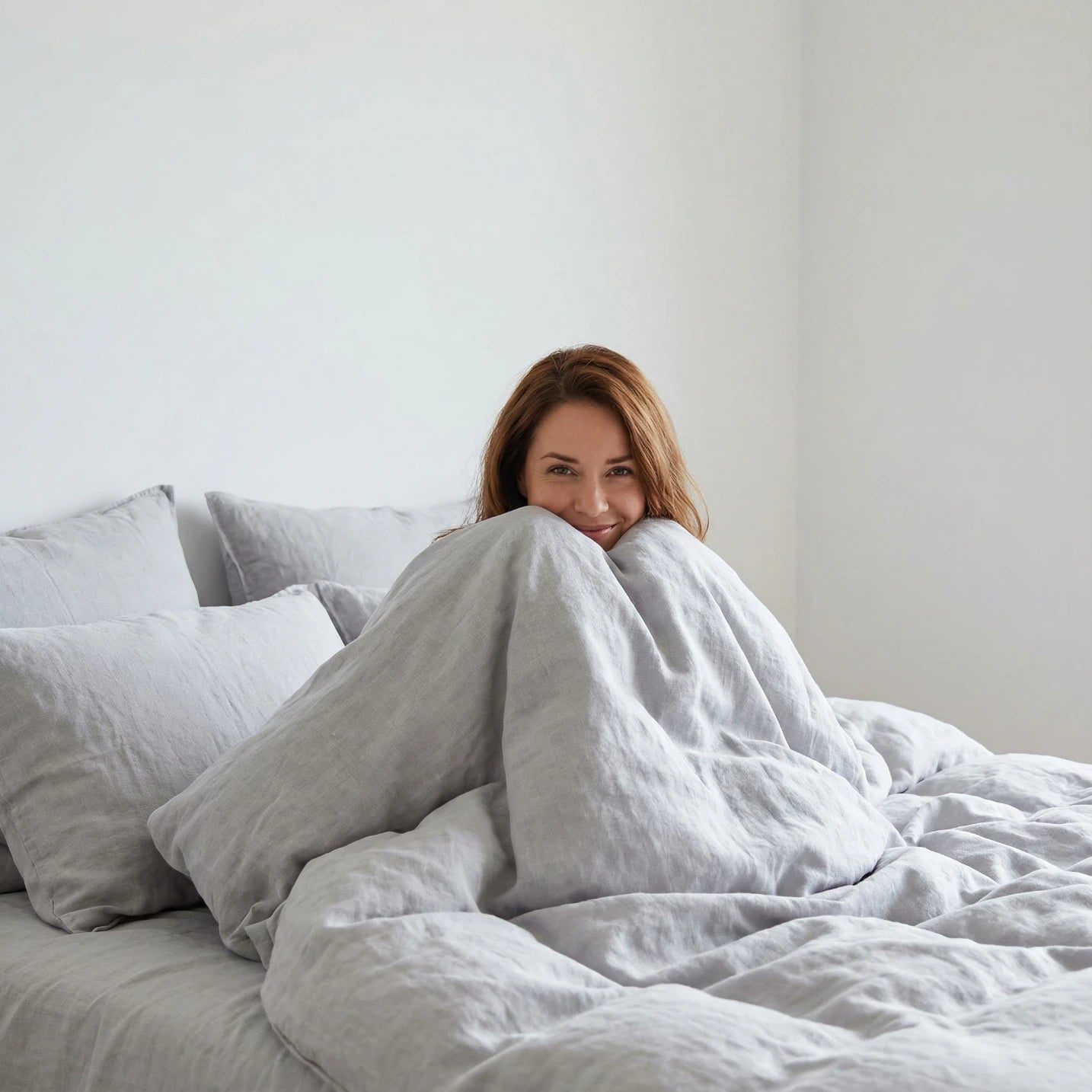
A hotel bed is a system, not a product. The reason your home bed doesn't feel like a hotel bed isn't usually the sheets — it's that you're missing two of the five layers. Hotels build their beds in a strict sequence: each layer does one job, and you cannot skip any of them and replicate the feel.
| Layer | What it is | Why hotels use it |
|---|---|---|
| 1. Mattress topper | 2–3 inch quilted or featherbed topper (down or down-alternative) | Adds the cloud-like sink. Most home beds skip this — it's the #1 missing layer. |
| 2. Fitted sheet | 300 TC white cotton percale, deep pocket | Holds the topper smooth. Deep pocket needed (15"+) once topper is added. |
| 3. Flat top sheet | Same fabric as fitted sheet | Hospital-corner tucked under mattress. Creates the crisp "envelope" feel. |
| 4. Duvet + cover | White cotton duvet cover over a separate medium-weight insert | Cover washes between guests; insert lasts years. Never a quilted comforter. |
| 5. Pillows (4) | Two soft, two medium-firm — all in white cotton percale cases | Stack of 4 (sometimes 6) is the visual signal of "luxury bed" plus genuine sleep utility. |
Notice what's missing from this list: thread count higher than 400, satin pillowcases, decorative throws, mattress protectors visible from above, anything that wrinkles or shows colour. Hotel housekeeping standards optimise for two metrics — visual uniformity at turndown and machine survivability through 200+ wash cycles. Everything else is decoration.
3. Hotel Pillows: The Real Answer (and Why You Need 4)
The single most-Googled question about hotel beds is some variation of "why are hotel pillows so good." The answer disappoints most people: hotel pillows are not, individually, particularly special. The trick is the stack. Most luxury hotels supply four pillows per guest — two soft and two medium-firm — and the variety is what creates the feeling of perfect support, because guests subconsciously stack and combine pillows until something works.
| Pillow type | Hotel use | Why |
|---|---|---|
| Down / down-alternative — soft | 2 per bed | For stomach sleepers and back-sleeper neck cradle |
| Down / down-alternative — medium | 2 per bed | For side sleepers and propped-up reading |
| Memory foam / latex | Rare | Doesn't compress for storage; doesn't survive bleach laundering |
| Buckwheat / latex shred | Wellness/spa hotels only | Niche — most guests find them too firm |
| Pillowcase fabric | 300 TC cotton percale, white | Same as sheets — must launder identically |
| Pillow protector | Always — under the case | Hidden zippered cover protects fill from oil and sweat |
The most common down-alternative fill in hospitality is microgel cluster fibre — synthetic clusters engineered to mimic down loft while being machine-washable on hot. If you're allergic to down or live with someone who is, microgel is the closest substitute. For home use, three pillows usually replicates the effect of four well enough.
4. Hotel Sheets: Percale, Not Sateen — and Why That Matters
Walk into any home goods store and the marketing pushes you toward sateen. Walk into a hospitality supply warehouse and the inventory is 90% percale. The reason is sensory and structural at the same time, and once you understand it, you stop wanting "silky" sheets.
| Property | Percale (hotels) | Sateen (department stores) |
|---|---|---|
| Weave | 1-over-1, balanced | 4-over-1, weft-faced |
| Hand | Crisp, paper-like, cool | Silky, slippery, warm |
| Breathability | High | Lower — denser yarn float |
| Durability | Excellent — survives 200+ washes | Snags easily — long floats catch |
| First-night feel | Fresh, slightly stiff, "ironed" | Slippery, lotion-like, warm |
| Sound when you slide in | Quiet whisper | Slick swish |
| Best for | Hot sleepers, hotel feel, year-round | Cool sleepers who want warm wrap |
That distinct cool, crisp sensation when you slide into a hotel bed for the first time on a long travel day? That's percale's 1-over-1 weave creating thousands of tiny air channels. Sateen physically cannot do that — its 4-over-1 weave is more closed, which is what makes it feel "warmer" and more enveloping. Both are valid for different sleepers, but only one is the hotel feel.
For a deeper material breakdown, our guide to the best organic percale sheets walks through which weights and finishes hold up over years.
5. The Duvet Trick: Cover + Insert, Never a Comforter
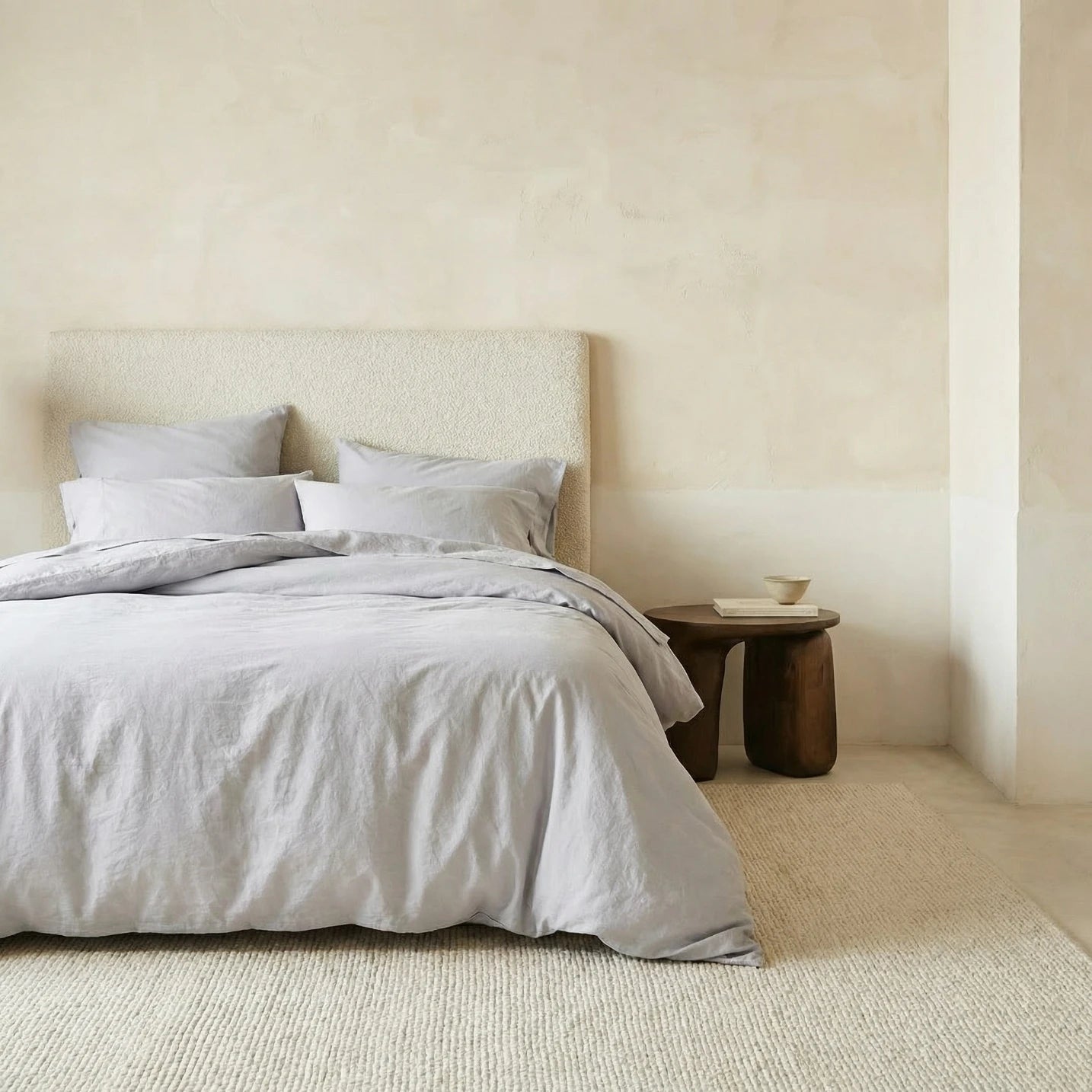
One of the most consequential differences between a hotel bed and a typical home bed is the top layer. Hotels almost universally use a white duvet cover with a separate insert — never a quilted comforter, never a coloured throw, never a stitched-in fill. The reason is operational: covers can be stripped and laundered between every guest, while the insert lasts for years. But the result is also aesthetic — a duvet cover with an insert drapes more loosely, creating that fuller, hotel-like loft.
| Spec | Hotel standard | Why |
|---|---|---|
| Cover material | 300 TC white cotton percale | Matches sheets — can be laundered identically |
| Closure | Hidden buttons or interior ties | Holds insert smooth, prevents bunching |
| Insert fill — temperate climate | Medium-weight (~600 fill power down or microgel cluster) | Year-round comfort across HVAC environments |
| Insert construction | Baffle box (not sewn-through) | Holds loft uniformly without cold spots at seams |
| Sizing rule | Insert sized 2–4" smaller than cover | Fills cover fully without cramping; better drape |
| Top sheet under duvet | Always (in US/UK chains) | Adds a temperature-regulation layer; some EU hotels skip it |
Quilted comforters can't replicate this. The fill is permanently sewn between the layers, so it can't be properly laundered after every use, the loft compresses unevenly over time, and the stitched channels create cold spots. Once you've slept under a true duvet-and-cover system, a comforter feels heavy and flat by comparison.
6. Hotel Bedding Brands vs the Better Alternative
The major hotel-brand bedding shops (the ones that sell the bed you slept in directly to consumers) all run the same playbook: list a 300–400 TC cotton percale set at 1.5–2× the price of an equivalent specialty-bedding brand, lean on the brand association, and rely on guests being unable to find the original textile mill. The honest comparison:
| Source | Typical material | Certification | Queen sheet set price band | What you're paying for |
|---|---|---|---|---|
| Major hotel-brand stores | 300–400 TC cotton percale | Usually none | $220–$350 | Brand royalty + nostalgia |
| Department-store "hotel collection" labels | 200–600 TC sateen, often poly-blend | Rarely OEKO-TEX | $100–$250 | Marketing — usually not actually hotel spec |
| Specialty DTC bedding brands | 300–400 TC cotton percale | OEKO-TEX or GOTS | $150–$280 | Same construction, lower margin, certified clean |
| B2B hospitality suppliers | 200–400 TC cotton or T200 poly-cotton | Industrial spec, no consumer cert | $80–$160 | Bulk/contract grade — built for laundering, not home softness |
| Or & Zon | 300 TC organic cotton percale or washed linen | GOTS-certified organic + OEKO-TEX | $170–$240 | Hotel construction + organic + Portuguese mill |
The takeaway: hotel-brand bedding stores aren't a scam, but they're priced for sentiment. The exact same fabric specification — 300 TC long-staple cotton percale — is available from specialty brands at 25–40% lower prices, often with the certifications that hospitality buyers don't bother with (organic, low-impact dye, microplastic-free). The only thing you don't get is the embroidered logo on the pillowcase.
7. The "Better Than Hotel" Setup
If you're going to replicate a hotel bed, the obvious next question is whether you can do better. The honest answer is yes — easily. Hotels are constrained by procurement realities (industrial laundering, low-cost-per-night, brand uniformity) that don't apply to your home. Three upgrades a hotel will almost never make:
- Switch to GOTS-certified organic cotton. Hotels rarely pay for the organic premium because their lifecycle cost model doesn't capture indoor-air-quality benefits. At home, GOTS-certified percale gives you the hotel weave without the formaldehyde-based wrinkle-resistance treatments common in conventional cotton bedding.
- Add washed linen for summer. Linen is too expensive and too high-maintenance for industrial laundering, so almost no hotel uses it. At home, a single set of washed linen sheets for warm months gives you a textile experience hotels can't deliver.
- Use a heavier insert. Hotels pick a single medium-weight insert that "works" across all guests and seasons. You can match a heavier winter insert and a lighter summer one to your actual climate.
If you want a single-product upgrade that does the most work, prioritise the duvet system. Our organic cotton duvet covers are cut to fit standard inserts with the 2–4" allowance hotels build into their spec, and they soften with every wash exactly the way percale should. For a complete reset, the bed bundles include sheet set, duvet cover, and pillowcases in coordinated white or natural — the hotel-formula starting point.
8. The 5-Step Hotel Bed Replication
Add a topper
2–3" quilted cotton or down-alternative featherbed. The single biggest "is this a hotel?" upgrade. Skip and the rest won't compensate.
Buy 300 TC percale
White or natural, deep-pocket fitted, matching flat top. Skip sateen, microfiber, "thread count 1,000" labels.
Use a duvet, not a comforter
Cotton duvet cover + separate medium-weight insert. Cover is 2–4" larger than insert for proper drape.
Stack 4 pillows
Two soft, two medium-firm. Down or microgel cluster fill. Always use a hidden zippered protector under the pillowcase.
Wash like a hotel
Hot wash (140–160°F) with a small splash of distilled white vinegar instead of fabric softener. Tumble dry low. Sheets become softer with every cycle.
Total damage if you start from zero, in 300 TC organic cotton: roughly $600 for the bare minimum (sheet set + duvet cover + pillowcases) up to $1,200 for the full setup including topper, insert, and four pillows. That's about a tenth of the cost of one hotel weekend per year — and the math compounds, because poor sleep costs the average insomniac worker $2,280 a year in lost productivity.
9. Frequently Asked Questions
What thread count do hotels actually use?
Most luxury hotels use 250–400 thread-count cotton percale. The 800-1,000 TC sheets advertised in department stores are typically achieved by counting plies rather than true single-yarn density — a marketing convention that hospitality procurement ignores. Above about 500 single-ply TC, sheets become hot to sleep on and start to fail under industrial laundering.
Why do hotel beds always use white sheets?
Three reasons, in order of importance: (1) all-white linens can be laundered with industrial bleach without colour loss, which is essential for sanitisation; (2) white visually signals cleanliness in a way coloured linens cannot; (3) standardising one colour across thousands of room-nights simplifies inventory and replacement.
Do hotels use down or down-alternative pillows?
Both — usually a mix. Down and feather blends are common in 5-star hotels. Microgel cluster fibre (a synthetic that mimics down loft) is increasingly standard because it's machine-washable on hot, hypoallergenic, and survives more laundering cycles than down. Most hotels supply two soft and two medium-firm pillows per bed.
What is the white triangle thing on hotel beds called?
That's the top sheet folded over the duvet at turndown, sometimes called the "fold-back" or "courtesy turn." It serves no functional purpose for the guest; it's a visual signal that the bed has been freshly made and turned down for the night.
Are "hotel collection" sheets at department stores actually hotel sheets?
Almost never. The "hotel collection" label at most US department stores is a brand owned by the retailer, with no relationship to actual hospitality procurement. Most are sateen or poly-blend at thread counts hotels don't use. Reading the materials and weave on the back of the package is more useful than the brand name on the front.
How do hotels make their beds so tight?
Two techniques: hospital corners on the flat top sheet (folded into a 45-degree triangle and tucked tightly under the mattress) and an oversized flat sheet that extends 18–24" beyond mattress edges. Some hotels also use a thin under-sheet over the topper to grip the corners. With practice, you can replicate this in about 90 seconds per bed.
How often do hotels replace their bedding?
Sheets and pillowcases are replaced when they show wear — typically every 12–24 months under industrial laundering. Pillows are replaced every 12–18 months. Duvet inserts and mattress toppers last 3–5 years. At home, with gentler washing, the same items last 2–3× longer.
What detergent do hotels use?
Industrial linen detergent at high temperatures (~160°F / 71°C) with low residual fragrance. Most hotels skip fabric softener entirely because it leaves residue that reduces percale's signature crispness. At home, a small splash of distilled white vinegar in the rinse cycle gives you the same effect — softening fibres without coating them.
Can I get the hotel feel with linen sheets instead of percale?
You can get a different premium feel — softer, more textured, slower to develop the "crisp" hand. Linen is too expensive and high-maintenance for hospitality, so it isn't the hotel feel, but it's arguably a better feel for home use. Many sleepers prefer linen in summer and percale in winter.
Is it worth buying directly from hotel-brand bedding stores?
Only if the brand association matters to you emotionally. The fabric is rarely better than what specialty bedding brands sell at 25–40% lower prices, and hotel-brand stores almost never carry organic certifications. If construction is what you're after, you can get hotel-equivalent sheets for less.
📚 Related Reading
Last updated: May 2026. We update this guide quarterly as hospitality-procurement specs and textile certifications evolve. Spotted a stale figure? Email us at hello@orezon.co.


Comments