
Quick Answer
The optimal bedroom temperature for sleep is 60–67°F (15.5–19.4°C), with 65–68°F the practical sweet spot for most adults. The reason is biological: your core temperature drops 1–2°F at sleep onset, and a cool room speeds that drop — so you fall asleep faster and reach deep sleep more efficiently. Ranges vary: infants 68–72°F, toddlers 65–70°F, adults 65–68°F, menopausal women often 60–65°F. Beyond the thermostat, breathable natural-fibre bedding (linen, cotton) regulates temperature all night where synthetics trap heat.
Key Takeaways
- Optimal range: 60–67°F (15.5–19.4°C), with 65–68°F the practical sweet spot for most adults.
- Cool rooms speed the 1–2°F core-temperature drop that triggers sleep onset and deep sleep.
- Ranges vary by group: infants 68–72°F, toddlers 65–70°F, menopausal women often 60–65°F.
- Too hot fragments sleep and cuts deep slow-wave sleep more than being slightly too cold.
- Bedding matters as much as the thermostat — breathable linen and cotton vs heat-trapping synthetics.
- Pair a cool room with natural-fibre bedding for temperature regulation that lasts all night.
When you sleep away from home — on a plane, in a hotel, or during a long layover — you lose control of the room. The bedroom-temperature rules above don't help you at 35,000 feet.
Related sleep-away-from-home guides:
→ The best position to sleep on a plane (ergonomics data)
→ Sleeping in airports 2026 — the global infrastructure ranking
The optimal bedroom temperature for sleep in adults is 60–67°F (15.5–19.4°C), with most clinical sources converging on 65–68°F (18.3–20°C) as the practical sweet spot. The reason is biological: your core body temperature drops by roughly 1–2°F at sleep onset, and a cool ambient room helps that drop happen faster — which means you fall asleep faster and reach deep slow-wave sleep more efficiently.
Different groups need different ranges: infants 68–72°F, toddlers 65–70°F, adults 65–68°F, menopausal women often 60–65°F, elderly 68–72°F. Couples with mismatched preferences need a 1–2°F compromise plus dual-fabric layering.
Above 75°F (24°C) sleep quality degrades sharply — slow-wave sleep drops, REM fragments, and night-time wake events climb. Below 54°F (12°C) the same happens in reverse — the body diverts blood to maintain core temperature, disrupting deep sleep. Humidity also matters: target 40–60% relative humidity regardless of temperature.
Researched and reviewed by the Or & Zon product team — drawing on the National Sleep Foundation (NSF), American Academy of Sleep Medicine (AASM), Harvard Medical School Sleep Health, Mayo Clinic, peer-reviewed publications in Sleep, Sleep Medicine Reviews, and the Journal of Physiological Anthropology, plus US CDC and WHO infant-sleep guidance.
Last updated: May 2026 · Reading time: 14 min · Data points: 25+ across 12 primary sources
📋 Key Takeaways
- The most-cited optimal bedroom temperature for adults is 60–67°F (15.5–19.4°C), per the National Sleep Foundation. Most adults find the practical sweet spot at 65–68°F (18.3–20°C).
- Core body temperature drops 1–2°F at sleep onset, peaking in its decline 2 hours after falling asleep. A cool room accelerates this drop.
- Slow-wave sleep (deep sleep) is the most temperature-sensitive sleep stage — even a 2–3°F deviation from optimal noticeably reduces it.
- Above 75°F, sleep quality degrades sharply: increased wake events, reduced REM, and delayed sleep onset.
- Below 54°F, deep sleep also drops as the body diverts metabolic energy to maintain core temperature.
- Infants need warmer (68–72°F); menopausal women often need cooler (60–65°F) due to hormonal thermoregulation changes.
- Humidity matters as much as temperature — target 40–60% relative humidity. HVAC heating drops indoor humidity to 20–30%, disrupting nasal passages and skin overnight.
- Temperature mismatched couples can use dual-fabric layering: linen for the warm sleeper, percale or sateen for the cooler sleeper.
- Bedding fabric is part of the bedroom climate. Polyester and microfibre raise local body temperature by 1–3°F vs cotton or linen.
- Smart thermostat overnight setbacks save energy but compromise sleep if they push the bedroom outside the 60–68°F window.
1. Why Bedroom Temperature Matters — The Thermoregulation Science
Sleep is, at the physiological level, a temperature event. The hypothalamus initiates the sleep cycle by lowering the body's thermoregulatory set point, and the body responds by dilating peripheral blood vessels (warm hands and feet are part of how you fall asleep) to dump core heat into the skin and out into the room. The room temperature is the receiving end of that heat transfer — when it's set right, the process completes efficiently and you fall asleep within 10–20 minutes. When it's wrong, the process stalls, and the result is the kind of restless, sweaty, kicking-the-duvet-off, dragging-it-back-on night most people know well.
Three measurable physiological changes happen as you transition into sleep:
| Stage | Body temperature change | Why room temperature affects it |
|---|---|---|
| Sleep onset (first 30 min) | Core temperature begins to fall ~0.5°F | A cool room accepts heat from the skin faster, accelerating sleep onset latency |
| Slow-wave sleep (deep, hours 1–3) | Core temperature reaches its lowest point — typically 1.5–2°F below daytime baseline | Most temperature-sensitive stage; warm rooms suppress slow-wave sleep significantly |
| REM sleep (cycles 3–5, hours 3–8) | Thermoregulation partially suspended — body becomes poikilothermic (more like a reptile than a mammal) | Without active thermoregulation, ambient temperature has direct, unbuffered effect on sleep stability |
| Pre-waking (final 60 min) | Core temperature rises back toward daytime baseline | A room that's too cold here can mimic the body's natural waking signal — causing early waking |
The most clinically interesting of these is the REM stage. During REM, your body's ability to shiver or sweat is partially suppressed — the nervous system is so engaged with dreaming and memory consolidation that thermoregulation gets parked. This is why a room that's slightly too warm or too cool feels worst in the second half of the night: you're entering longer REM cycles with no biological backup against the room.
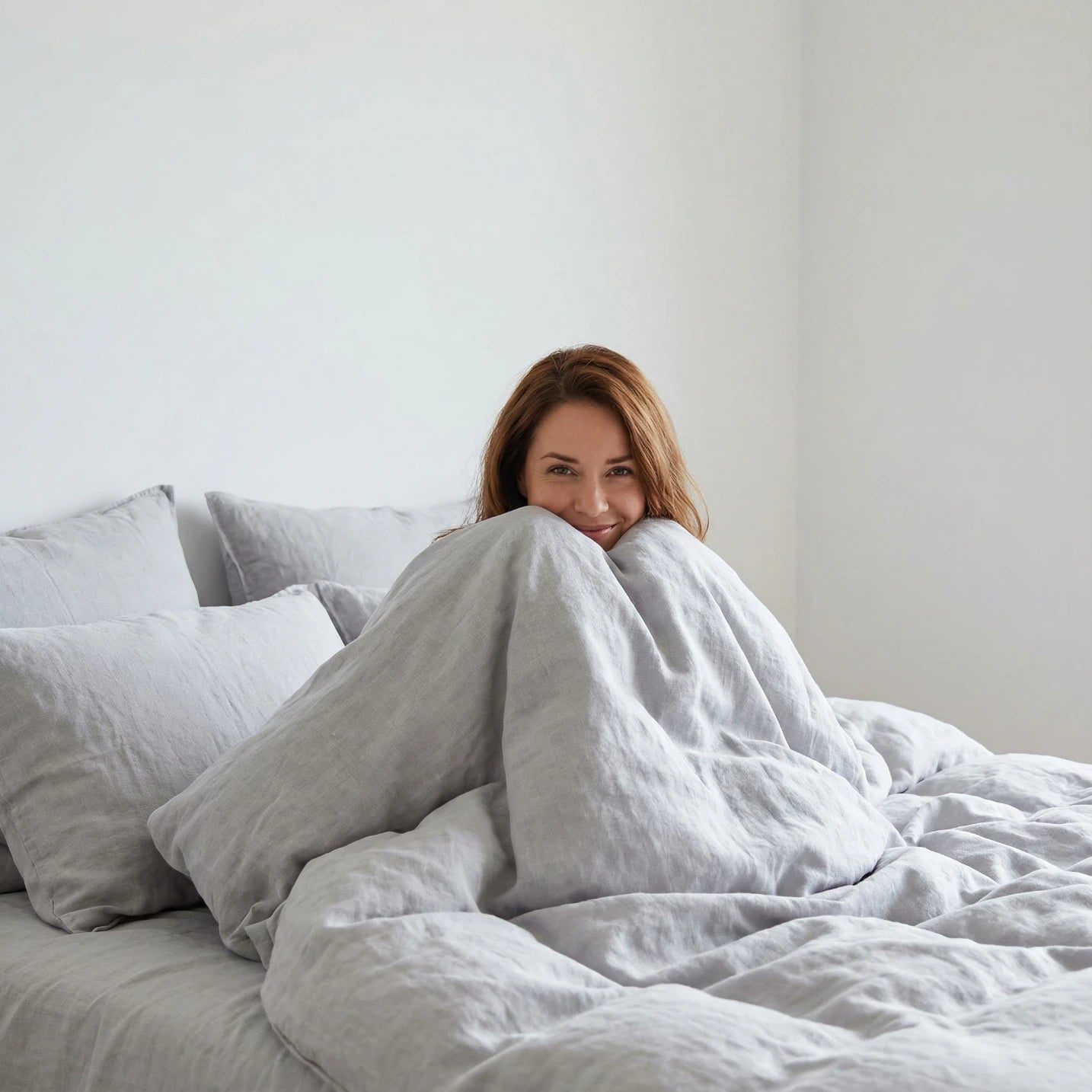
2. The Optimal Range — What the Research Actually Says
Multiple primary sources have published bedroom-temperature recommendations, and the ranges cluster tightly. Here are the figures most commonly cited in clinical sleep guidance:
| Source | Recommended range | Reference |
|---|---|---|
| National Sleep Foundation (NSF) | 60–67°F (15.5–19.4°C) | NSF, Best Temperature for Sleep |
| American Academy of Sleep Medicine (AASM) | ~65°F (18.3°C) optimal | AASM sleep-environment guidance |
| Harvard Medical School (Sleep Health) | 65–68°F (18.3–20°C) | Harvard Healthy Sleep |
| Mayo Clinic | ~65°F (18.3°C) | Mayo Clinic sleep environment guide |
| Cleveland Clinic | 60–67°F (15.5–19.4°C) | Cleveland Clinic sleep recommendations |
| Journal of Physiological Anthropology | Thermoneutral zone with bedding ≈ 60–66°F | Okamoto-Mizuno & Mizuno, 2012 |
| WHO indoor housing guidelines | Minimum 64°F (18°C) — bedrooms | WHO Housing and Health Guidelines, 2018 |
The convergence is striking. Across independent sources, the optimal range for healthy adults sits between 60°F and 68°F. The variation within that range usually comes down to individual thermoneutral zone — the personal temperature at which your body is in thermal equilibrium with the environment without sweating, shivering, or vasoconstricting. Lean adults, women, and older sleepers typically have higher thermoneutral zones (need slightly warmer rooms); muscular adults, men, and pregnant or perimenopausal women typically have lower ones (need cooler rooms).
3. Optimal Bedroom Temperature by Age and Life Stage
The "65°F is best" headline holds for healthy adults but not for every population. Infants in particular sit in a different range, and getting it wrong has clinical implications (overheating is a documented Sudden Infant Death Syndrome risk factor). Here are the recommended ranges across the lifespan:
| Age / Life stage | Recommended bedroom temperature | Why it differs |
|---|---|---|
| Newborns (0–3 months) | 68–72°F (20–22°C) | Underdeveloped thermoregulation; overheating is a SIDS risk factor (US CDC) |
| Infants (3–12 months) | 68–72°F (20–22°C) | Limited surface-area-to-mass ratio; lose heat faster than adults |
| Toddlers (1–3 years) | 65–70°F (18.3–21°C) | Thermoregulation maturing; can use sleep sacks instead of loose bedding |
| Children (4–12 years) | 65–70°F (18.3–21°C) | Higher metabolic rate than adults; tolerate slightly cooler bedrooms |
| Adolescents & adults (13–60) | 65–68°F (18.3–20°C) | Standard adult thermoneutral zone with light bedding |
| Pregnant women | 63–66°F (17.2–18.9°C) | Higher baseline metabolism; second/third trimester core temp ~0.5–1°F higher |
| Perimenopausal / menopausal women | 60–65°F (15.5–18.3°C) | Hormonal thermoregulation disruption; hot flashes peak overnight |
| Adults 60+ | 68–72°F (20–22°C) | Reduced subcutaneous fat; slower vasodilation response; cold sensitivity rises with age |
Two clinical notes worth flagging. First, infant overheating is a documented Sudden Infant Death Syndrome (SIDS) risk factor per US CDC and AAP guidance — never err on the side of warmer for newborns; their inability to thermoregulate makes the consequences of a too-warm room more severe than a too-cool room. Second, the menopausal range of 60–65°F is consistently lower than population guidance because hot flashes peak in the second half of the night, exactly when REM sleep is most temperature-vulnerable. For the full menopause-bedding setup, see our guide to the best sheets for menopause and perimenopause.
4. What Happens When the Room Is Too Hot or Too Cold
Sleep quality doesn't degrade linearly with temperature. There's a relatively flat-bottom "good zone" between roughly 62°F and 70°F, then degradation accelerates sharply outside that band. Here's what the literature documents at the boundaries:
| Bedroom temperature | Effect on sleep |
|---|---|
| Above 80°F (27°C) | Sleep onset latency lengthens; slow-wave sleep significantly suppressed; multiple wake events per night; cognitive impact equivalent to losing 2 hours of sleep |
| 75–79°F (24–26°C) | Reduced REM sleep, increased night sweating, more fragmented sleep architecture |
| 70–74°F (21–23°C) | Mild reduction in slow-wave sleep; tolerable for most cooler-blooded sleepers |
| 65–68°F (18.3–20°C) | Optimal range for most adults. Slow-wave sleep maximised, REM stable, sleep onset latency minimised |
| 60–64°F (15.5–17.7°C) | Acceptable with adequate bedding; ideal for menopausal women, hot sleepers, athletes |
| 54–59°F (12–15°C) | Body diverts metabolic energy to maintain core temperature; slow-wave sleep declines; muscular tension on waking |
| Below 54°F (12°C) | Significantly disrupted sleep; risk for elderly and those with cardiovascular conditions; WHO flags as below the safe-housing minimum |
The asymmetry is worth noting: most healthy adults tolerate slight cooling better than slight warming, because they can compensate with bedding (more layers add 1–2°F of effective warmth easily). Compensating for a too-warm room is much harder — a fan helps, but you can't take off bedding past zero, and you can't reduce body heat output below your basal metabolic rate.
5. Humidity — The Forgotten Half of the Equation
Bedroom temperature gets all the attention, but relative humidity is part of the same biological problem. Sweat evaporation is a major mechanism by which the body sheds heat, and evaporation efficiency depends on humidity. A 70°F bedroom at 30% humidity feels different from a 70°F bedroom at 60% humidity — the second one suppresses sweat evaporation, making the same temperature feel several degrees warmer.
| Relative humidity | Effect on sleep environment |
|---|---|
| Below 30% | Dries nasal passages and skin; aggravates eczema and respiratory conditions; common in winter HVAC heating |
| 30–40% | Acceptable but on the dry side — most HVAC-heated bedrooms in winter sit here |
| 40–60% | Optimal range. Skin and respiratory comfort maintained; dust-mite growth controlled |
| 60–70% | Tolerable but encourages dust mite proliferation; sweat evaporation efficiency drops |
| Above 70% | Mould and mite risk; significantly impaired thermoregulation; common in tropical climates and basement bedrooms |
The single most cost-effective sleep upgrade for many homes is a cool-mist humidifier in winter (target 40–50%) or a dehumidifier in humid summers (target 50–55%). Both are roughly $40–$120 and resolve the asymmetric humidity drift HVAC creates. For households dealing with allergens, our non-toxic bedding guide covers the dust-mite-and-allergen relationship in more detail.
6. The Couples Problem — Mismatched Sleep Temperatures
One of the most common bedroom-temperature problems isn't physical — it's interpersonal. Most heterosexual couples are temperature-mismatched: men typically prefer rooms 1–3°F cooler than women, and the difference compounds during the menopause transition when many women's preferred bedroom temperature drops further still. The result is the *thermostat war*, and it's a documented contributor to sleep disruption for one or both partners.
The good news: the solution isn't usually winning the thermostat. It's splitting the layered bedding so each sleeper has the right thermal envelope at the same room temperature.
| Strategy | How it works | When to use |
|---|---|---|
| Set the room cool (65°F), warmer sleeper layers up | Easier to add insulation than remove it; cool room benefits the warmer sleeper biologically | Most couples — works ~80% of the time |
| Dual-fabric layering | Linen on the warmer sleeper's side, percale on the cooler sleeper's side — different thermal properties from same colour palette | Visible-aesthetic-friendly compromise |
| Two separate duvets (Scandinavian sleep) | Each partner has their own duvet weight; common across Northern Europe | Severe mismatches; menopausal years; chronic temperature conflict |
| Different TOG-rated duvets seasonally | 4.5 TOG summer / 10.5 TOG winter, with each partner using different weights at the same time | Year-round mismatch with strong seasonal swing |
| Cooling/heating mattress pad | Active temperature control on each side (BedJet, Ooler, Eight Sleep) | Severe mismatches with budget for $700–$3,000 device |
— Or & Zon —
Shop Organic Bedding
The full Or & Zon edit · GOTS-certified organic cotton & stonewashed linen · made in Portugal.
7. The Bedding Layer — Why Fabric Is Part of the Bedroom Climate
Bedroom temperature isn't only the room — the microclimate against your skin matters more biologically than the macroclimate of the air around the bed. Two beds at 68°F can feel completely different depending on what's between you and the air.
Fabric affects bedroom temperature in two ways: insulation (how much heat the fabric traps against your skin) and moisture management (how efficiently the fabric moves sweat away so it can evaporate). Synthetic fabrics fail on both — they insulate moderately but trap moisture, raising local body temperature 1–3°F above what natural fibres at the same loft would produce.
| Fabric | Effective bedroom temperature offset | Best for |
|---|---|---|
| Washed linen | Feels ~2°F cooler than cotton percale at same room temp | Hot sleepers, menopausal women, warm climates |
| Organic cotton percale | Neutral baseline — designed for the 65–68°F range | Year-round adult sleepers |
| Cotton sateen | ~1°F warmer than percale | Cool sleepers, winter use |
| Flannel / brushed cotton | ~3–5°F warmer than percale | Cold bedrooms, winter only |
| Polyester / poly-cotton | ~2–3°F warmer (heat-trapping, no moisture management) | Avoid for chronic temperature problems |
| Microfibre | ~3°F warmer (worst moisture management of all common fabrics) | Avoid for hot sleepers entirely |
The practical implication: a 70°F bedroom with linen sheets feels biologically like a 68°F bedroom with cotton percale. If your room can't reach the optimal range — common in apartment buildings with limited HVAC control — switching to linen or percale gets you a 1–2°F effective offset for the cost of a sheet set, often more impactful than fighting the thermostat. For a deeper textile breakdown, see our linen versus cotton comparison.
8. The Smart-Thermostat Compromise
Most modern thermostats default to "energy-saving" overnight setbacks — typically dropping the temperature 5–8°F below daytime setting in winter, or letting it rise 5–8°F above daytime setting in summer. This generally aligns with sleep guidance, but only if the resulting temperature stays within the 60–68°F adult window.
| Daytime setting | Recommended overnight setback | Resulting bedroom temp |
|---|---|---|
| Winter, daytime 70°F | Set thermostat to 65–66°F overnight | ~65°F — optimal adult range |
| Winter, daytime 72°F | Set thermostat to 67–68°F overnight | ~67°F — optimal cool-tolerant adult range |
| Summer, daytime 75°F | Hold thermostat at 68–70°F overnight | 68–70°F — upper edge of adult range, accept mild reduction in slow-wave sleep |
| Summer, daytime 78°F+ | Hold at 70°F overnight if budget permits; otherwise use a fan + dehumidifier and switch to linen | 70°F + circulation — bedding compensation matters here |
One overlooked factor: thermostats measure the room they're in, not the bedroom in most US homes. If your thermostat is in the hallway and your bedroom is at the end of the house, the bedroom is often 2–4°F different from the thermostat reading. A $15 thermometer-hygrometer on the nightstand resolves the unknown — measure for one week and adjust setpoints accordingly.
9. The Cost of Getting It Wrong
Persistent bedroom-temperature problems compound. Insufficient slow-wave sleep across years correlates with cardiovascular, metabolic, cognitive, and mental-health outcomes documented across decades of clinical sleep research. Beyond the health side, the economic side is significant: insufficient sleep costs the United States up to $411 billion a year per RAND Europe (2016), and bedroom-temperature disruption is one of the modifiable causes that doesn't require behavioural change to fix — it just requires a thermostat, a fan, a humidifier, and the right bedding.
For the broader economic picture, see our cost of bad sleeping guide. For audience-specific solutions, our guides cover cooling sheets for menopause, bedding for night sweats and hot sleepers, and bedding for dry and aging skin — all of which build on the temperature foundation laid out here.
10. The 5-Step Bedroom Temperature Protocol
Measure your actual bedroom
A $15 nightstand thermometer-hygrometer for 7 days. Don't rely on the hallway thermostat — bedrooms run 2–4°F different from where the thermostat sits.
Set the target by demographic
Adults 65–68°F. Menopausal 60–65°F. Infants 68–72°F. Elderly 68–72°F. Couples: pick the cooler partner's range, layer up the warmer.
Address humidity
Target 40–60%. Cool-mist humidifier in winter; dehumidifier in humid summer. $40–$120, recoups in sleep quality fast.
Match bedding to climate
Linen for hot rooms or hot sleepers (-2°F effective offset). Percale year-round neutral. Skip polyester and microfibre — they undo the thermostat work.
Re-test seasonally
What works in May fails in February. Re-measure each season; adjust thermostat setbacks; rotate seasonal duvet weights (4.5 TOG summer, 10.5 TOG winter).
11. Frequently Asked Questions
What is the ideal bedroom temperature for sleep?
For healthy adults, 65–68°F (18.3–20°C), with the broader optimal range being 60–67°F (15.5–19.4°C) per the National Sleep Foundation. The exact best temperature within that range depends on age, sex, hormonal status, and bedding.
Is 72°F too warm for sleeping?
Slightly warm but not necessarily disruptive. At 72°F most adults still sleep well if humidity is controlled and bedding is breathable. Above 75°F, sleep architecture starts to degrade noticeably for most people.
Why do I sleep better in a cold room?
Because your core body temperature drops 1–2°F at sleep onset, and a cool room helps that drop happen faster. Cold rooms also stabilise REM sleep, when your thermoregulation is partially suspended and ambient temperature has direct biological effect.
What temperature should a baby's room be?
Per the AAP and US CDC, 68–72°F (20–22°C) for newborns and infants. Overheating is a documented Sudden Infant Death Syndrome (SIDS) risk factor — never err warmer for babies than this range.
Is it OK to sleep with the AC at 68°F?
Yes — 68°F is within the optimal adult range. The only consideration is humidity: AC removes moisture aggressively, so if your bedroom drops below 30% relative humidity, add a cool-mist humidifier.
Why is my bedroom always hotter than my thermostat reading?
Most thermostats are in hallways or central living spaces. Bedrooms typically run 2–4°F warmer (closed doors, body heat from sleepers, less airflow). A $15 nightstand thermometer reveals the actual temperature.
Does humidity affect sleep as much as temperature?
Yes — humidity affects how efficiently your body sheds heat through evaporation. A 70°F room at 60% humidity feels biologically like a 73–74°F room at 40% humidity. Target 40–60% relative humidity regardless of temperature.
What bedding fabric is best for hot bedrooms?
Washed linen — feels ~2°F cooler than cotton percale at the same room temperature. Skip polyester and microfibre, which trap heat and moisture. For more, see our night sweats and hot sleepers guide.
Is it normal for couples to disagree on bedroom temperature?
Common — most heterosexual couples are 1–3°F mismatched, and the gap widens during the menopause transition. The fix is usually dual-fabric layering or two separate duvets, not winning the thermostat fight.
How much energy do I waste keeping the bedroom cold?
Less than you'd think. The US Department of Energy notes that an 8°F overnight setback (e.g., 73°F day → 65°F night) saves about 10% on annual heating costs while aligning with optimal sleep guidance. The savings and the sleep recommendations point in the same direction.
📚 Related Reading
📚 Methodology and Sources
- National Sleep Foundation — Best Temperature for Sleep guidance
- American Academy of Sleep Medicine (AASM) — sleep environment recommendations
- Harvard Medical School — Healthy Sleep programme
- Mayo Clinic — sleep environment guide
- Cleveland Clinic — sleep recommendations
- WHO — Housing and Health Guidelines, 2018
- Okamoto-Mizuno & Mizuno — Effects of Thermal Environment on Sleep and Circadian Rhythm, Journal of Physiological Anthropology, 2012
- RAND Europe — Why Sleep Matters: Quantifying the Economic Costs of Insufficient Sleep, 2016
- US CDC — Safe Infant Sleep recommendations
- American Academy of Pediatrics (AAP) — SIDS prevention guidelines
- US Department of Energy — Programmable thermostat efficiency notes
- Sleep Medicine Reviews — peer-reviewed thermoregulation and sleep architecture literature
Last updated: May 2026. We update this page as new sleep-environment research is published. Spotted a stale figure? Email hello@orezon.co and we'll verify or replace it.
— Or & Zon —
Ready to upgrade to organic?
Or & Zon's full GOTS-certified edit — organic cotton percale, sateen, and stonewashed French linen. Sheets, duvet covers, pillowcases. Hand-finished in Portugal.


Comments